
EP 7: The Freedom Gap
How to Stop Being the Bottleneck in Your Business
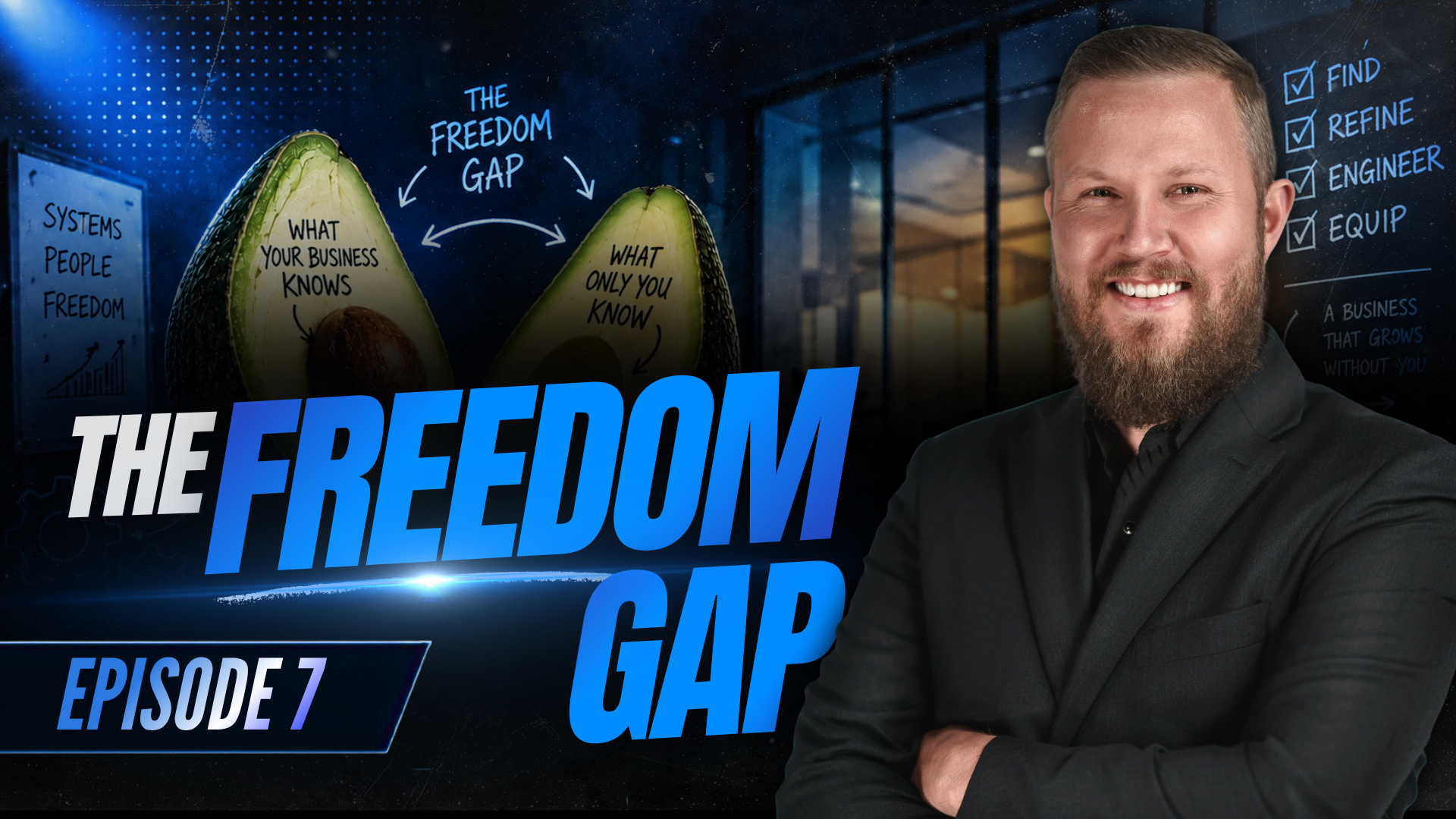
If you want to stop being the bottleneck in your business, picture an avocado cut in half. The pit in the middle is everything your business already knows: what's written down, what your team can handle without calling you. Everything surrounding that pit is everything only you know.
For most owners, that's a lot, and the space between the two is what I call the freedom gap. The bigger that gap, the more your business still depends on you.
What Actually Counts as Dependency, Versus Normal Questions?
The goal isn't a business where nobody ever asks you anything again, that's not realistic, and you're still the owner.
But if your scheduler asks the same type of question every week, your sales team can't quote a job without you, or your manager needs your approval for every unhappy customer, that's not communication anymore.
That's dependency, and it's expensive.
It slows the business down, and it keeps part of your brain working all the time instead of resting on the things that actually matter.
How Do You Actually Close the Freedom Gap?
I use a simple four-step process I call the FREE framework:
- Find the knowledge trapped in your head, your manager's head, or your leader's head
- Refine it from a vague instinct into an actual standard
- Engineer it into something your team can access, a checklist, a video, a decision tree, even three sentences
- Equip your team to actually use it, instead of just filing it away
How Do You Find What's Actually Trapped in Your Head?
The easiest place to look is your interruptions.
For one week, every time someone asks you a question that requires your judgment or experience, write it down.
How much should I charge for this?
Can I give this customer a credit?
Should we send this employee home?
What do we do when the cleaner can't get into the house?
Don't get annoyed by the questions, they're your business handing you a map.
Most owners skip straight to "I need to write SOPs for everything."
Start by finding where the dependency actually is instead.
What Does It Mean to Refine the Answer?
Sometimes what feels like a process is really just a vague expectation.
"Take care of the customer" isn't a standard, it's a feeling.
How fast should a complaint get a response?
Who's allowed to offer a credit, and how much?
When does something need to be escalated?
You may realize you've been deciding case by case for years with no actual rule.
That's fine, it just means it's time to draw the line and set the standard going forward.
What Does Engineering the System Actually Look Like?
It doesn't have to be a two hundred page binder with screenshots and a table of contents, I've built that, and it wasn't the answer.
If the answer is a checklist, make a checklist.
If someone needs to see it done, record yourself doing it, even just on your phone.
If it's a decision, build a simple decision tree.
If it can be explained in three sentences, write three sentences.
The point isn't to create something impressive, it's to move the knowledge out of your head and into your business.
Why Do Documented Systems Still Get Ignored?
This is the step most owners skip.
You can have a beautiful SOP library, folders inside folders inside folders, and still have everyone asking the owner for answers.
At that point it's not a documentation problem anymore, it's a behavior problem.
Your team has to be taught where the answer lives and when they're expected to use it.
And sometimes you have to stop rescuing your team.
If someone asks something that's already documented, don't just answer it, ask "what does the SOP say?" or "did you check the process?" as a teaching moment.
If they genuinely can't find the answer, that's a new golden nugget, a process you still need to build.
Where Should You Actually Start?
You don't need to fix a thousand things in your head at once.
Ask yourself three questions:
- What am I constantly being asked?
- What am I constantly fixing?
- What would break if I disappeared for two weeks?
Pick one thing off that list and run it through find, refine, engineer, equip.
Then do another.
That's how the freedom gap actually closes.
Want a Simple Way to Create and Organize Your SOPs?
If you want a simple way to create and organize your SOPs, check out Sophie at sophiehq.com.
Resources & Links
Visit: https://bit.ly/JhonLeBaron
Download the Free Resource: https://bit.ly/Jhons5Reasons
Facebook: https://bit.ly/JhonLeBaronFacebook
Instagram: https://bit.ly/JhonLeBaronInstagram